
“The role of Pan-African parliament in mobilizing support for eradicating poverty in Africa"
“Overcoming poverty is not a gesture of charity, it is an act of justice.”- Nelson Mandela
Introduction and Background
Poverty has been Africa’s perennial challenge over time, despite the fact that the continent is blessed with all the wealth-creating resources. The continent is endowed with the richest natural resources such as oil, gold, diamond, land, and a favourable climate, yet the continent is still poor and stagnant when it comes to development. Africa is the world’s poorest continent. Most African citizens and countries live in in abject poverty, despite the fact that most African governments have signed and ratified a number of protocols and agendas that seek to fight and eradicate poverty in Africa. Sustainable development goals, which are global goals set up in 2015 by the United Nations General Assembly and are intended to be achieved by 2030, include the eradication of extreme poverty and African countries are signatories to these goals and have committed to fight hard to achieve them by 2030. This year marks the 35th anniversary of the World Day to Overcome Extreme Poverty and the 30th Anniversary of the international day to eradicate poverty. This is a day which offers a platform to people who are living in poverty and extreme poverty to talk about their lives and their poverty struggles. While Africa and the World will commemorate this day, it comes under the backdrop of lived poverty being on the rise.
The latest Afrobarometer surveys on poverty indicate that lived poverty in Africa is on the rise with 33 countries’ “severe lived poverty” rate going up to 19% from 17% (Mattes, 2020). Presented with this rise in poverty, there is a need for Africa to address a number of challenges that are hindering the eradication of poverty. These include corruption, poor governance, limited employment opportunities, poor infrastructure, poor resource usage, wars and unending conflicts, and poor World Bank and IMF policies, etc. With the continent facing a rise in poverty levels, it is imperative that member states, individuals, African Union organs, such as the Pan-African Parliament, play their part in addressing these challenges in order to eradicate poverty in Africa. The Pan-African Parliament, being an important African Union organization, is also strategically positioned to advance policies that can retrieve Africa from the doldrums of poverty. This paper will focus on how the Pan African Parliament can play a key role in pushing national legislatures to support poverty eradication in Africa. Focus will also be placed on the Pan-African Parliament that can use data-based evidence to influence the enactment of legislation and policies that advance the eradication of poverty.
Conceptualising Poverty
Poverty is a relative concept, and it is interpreted and understood differently by people, organizations, states, government, etc. Defining poverty is a very challenging, as poverty has different meanings attached to it and this affects on its bearing on society. Taking a closer look at the plethora and varied meanings of poverty what is of importance is that, in all the definitions, what is central and mutual is the issue of material inadequacy. Scholars, such as Ramphoma (2014:60), argue that “poverty is more than just having enough income to live by”. This, in essence, means that poverty is a multi-facetted phenomenon which encompasses a number of critical dimensions of living standards, such as income, consumption, health and education, etc. Thus, the direction that public and private initiatives take regarding poverty mitigation, determines how poverty can be defined. There is an understanding that there are varying perceptions on what poverty is and these include;
1. Deprivation of basic needs- The International Labour Office (ILO, 1992:46) argues that in defining poverty, focus is on the state of deprivation. The ILO reiterates that, in most cases, there are varied explanations or definitions as to what is regarded as a basic need or necessity by people. The labour office argues that personal needs and basic needs differ from place to place and time to time. For instance, what might be regarded as a need in South Africa may simply be regarded as a want in Zimbabwe or Malawi. According to Ramphoma (2014), needs can be clustered into two categories which include minimum requirements, and these include adequate food, shelter, clothing and household equipment and furniture. The second category includes essential services which include clean drinking water, sanitation, public transport, health, and education facilities.
2. Political and cultural influences- Poverty can be defined from a political and cultural standpoint. As a result, there is an undisputed supposition concerning the existence of a cause-and-effect relationship between the two (Poverty and Inequality Report, 1998). Under this understanding, it can be argued that an existing political climate in any country, community or village can determine how poverty is defined and understood. Furthermore, the fact that South Africa has a number of cultural groups can also be used as locus standi in defining poverty as individuals can be seen as poor or better off, basing on the cultural group to which they belong.
3. Absolute and relative approach to poverty- Other scholars are of the view that poverty can be defined from a cash income basis. An important criticism of that definition is that it snubs non-cash benefits and also does not subtract taxes. Literature from scholars, such as Pecora, Whittaker and Maluccia (2009), indicate that non-cash benefits and taxes do have an impact on the family or individual’s standard of living and should not be ignored when defining poverty. Absolute poverty, according to Baumol and Blinder (2009:448), recognises or defines poverty as a failure of needs fulfilment, which has a detrimental effect on the individual or family’s ability to function sufficiently in society. Furthermore, the relative approach to poverty is of the view that individuals and families who are situated at the bottom of the economy are poor.
For the purpose of this paper, Saunders’s (1997) definition of poverty will be used, which is involuntary restrictions on choice, which is based on a particular society or culture.
Types of poverty
Having defined what poverty is, it is important to note that there are different types of poverty in Africa. In a bid to try and understand the challenges affecting poverty eradication in Africa, it is crucial that one differentiates between the different categories of poverty (Rao and Walton, 2004:16). The classifications by Jense (2009) on the types of poverty need to be understood and taken into account if one wants to understand the challenges of poverty eradication in Africa. According to Jense (2009), there are four types of poverty, and these include:
a) Rural poverty- Jense (2009) argues that it is poverty that occurs in rural areas where the population figures are below fifty thousand and where there are numerous single guardian households, and where families are facing challenges of access to services, provision for disabilities and quality education opportunities.
b) Urban poverty- This is poverty that occurs in the metropolitan where the population size is around fifty thousand. Citizens in the urban areas, according to Jense (2009), deal with a multifaceted collective of protracted and dire stressors. These people, Jense further argues, are dependent and poverty often has a bearing on insufficient large city services.
c) Situational poverty- This exists as a result of a disaster or loss that has occurred and, in most cases, is impermanent. Situational poverty can be triggered by environmental disasters, divorce, or severe health problems, etc.
d) Generational poverty – Jense (2009) states that this type of poverty happens when at least two generations have been born into poverty. Chances are very high that those who are born into this kind of poverty will probably undergo this type of poverty. It is very problematic, if not challenging, for families who are living in this kind of poverty to move out easily from this state of affairs.
Causes of Poverty in Africa
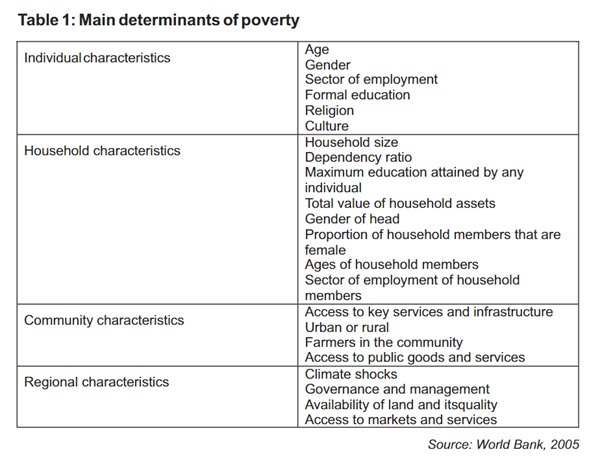
Africa, as a continent that boasts of a number of natural resources that are able of extricating it from the shackles of poverty, suffers from an increase in poverty. A number of factors cause poverty in Africa and these factors, according to White and Killick (2001:30), are “causes of poverty in Africa are multi-faceted and include economic, social and political, international and national (macro and micro) factors” (See Table 1). These factors include corruption and poor governance, limited employment opportunities, poor infrastructure, poor resource usage, wars and unending conflicts, and poor World Bank and IMF policies, etc. While the factors are numerous, it should be agreed that the flaws in a number of African states’ political systems and the social forces are significant primary causal factors that are core to the poverty problems that are bedevilling the continent.
1. Corruption- Corruption has become cancerous in most African countries as more and more leaders are involved in corrupt activities. Money or resources that are meant to be spent on service delivery, for example, is now being syphoned into corrupt leader’s pockets and this then leads to government departments being unable to deliver services to the public, thereby plunging the majority into abject poverty. These corrupt activities have led to a number of African states failing to implement programmes designed to address poverty as resources meant for these programmes end up being misappropriated. This misappropriation of public funds produces an unevenness in society and leads to more poverty. Covid funds are a sample case, where, in a number of African countries, such as Zimbabwe and South Africa, the money meant to buy vaccines, personal protective equipment (PPE) for the public was misappropriated, leading to a number of ordinary people being affected and placed at the edge of the economy.
2. Poor Governance- Bad governance is another root cause of poverty in Africa. Africa, as a continent is blessed with resources, but is the poorest in the world. The major causes and problems affecting human development in Africa have been inflicted by elites. Africa faces a challenge or a deficit of good leadership. Rule of law, respect for the constitution, strong institutions, are alien to most African countries as the continent has over the years “focused” on building strong men and not strong institutions. This has led to cases of state and judicial capture which has become a topical discussion in counties, such as, Zimbabwe and South Africa. The by-product of poor governance in Africa has been the rise in poverty levels. The “strong men” and “big men” philosophy has resulted in only a few having a voice in the decision-making in national affairs and they are placed in positions where the decisions they make only favour them and not the majority.
3. Civil Wars and Coups- The continent has been unstable and in the past few years, it has witnessed a number of coups. These coups have affected and destabilised a number of African countries, such as Burundi and Sudan. In Ethiopia, the Tigray war has been on-going and the war has also destabilised that region despite calls by both regional and international bodies to have the war end. In Somalia’s religious war[1] has been worsening the famine situation there as well. These wars and coups that are, more and more, becoming fashionable in Africa render war/coup zones unproductive. No investor would want to invest in a country that is in a war or is going through a coup. These coups and wars scare away potential investment which would help nurture economic development and generate employment opportunities that would fight poverty in the continent.
4. Poor infrastructure- Real economic development that will fight poverty in Africa can be driven by proper infrastructure, which is a major problem in Africa. The continent battles with the challenge of lack of infrastructure that is crucial in driving economic development. African countries, such as Malawi, have poor roads, railways, water systems, etc., whereas these are some of the main drivers of economic development. While some African countries, such as South Africa and Zambia, are trying to catch up, they still have a long way to go as only urban areas have been developed over rural areas, which are mostly occupied by the largest fraction of the population.
5. Prevalence of diseases- The prevalence of diseases in Africa is also another major cause of poverty. Africa does not have adequate health facilities and personnel that can deal with or handle some of diseases and as a result, the continent’s population is heavily impacted by these diseases. For instance, diseases such as Ebola, HIV and AIDS, TB, COVID19, have strained the already incapacitated health system and thus continuing to plunge the continent into poverty. Diseases are a cause of poverty in the sense that in most African countries, government no longer or does not subsidise health, causing families of the affected by any of the diseases, to draw from the pint-size resources available and spend it on treating the sick.
6. Structural Adjustment Programmes- The loans dished out to many African countries in the 1990s have proved problematic over time and their effects are still being seen, and it is one of the causes of poverty in Africa. The loans with their strict conditions caused poverty in Africa, as they led to a number of individuals facing unemployment and called for a reduction in total government spending which affected major social sectors, such as education, health, and infrastructure, which are drivers of economic development.
State of Poverty in Africa
Africa is still struggling in dealing with poverty as poverty rates still remain high (See Figure 2). An estimated 40% of people in Africa live below US$1.90 a day (Donnenfeld, 2020). According to the World Bank, Africa is lagging behind the rest of the world. In the Sub-Saharan region, the overall number of people who are extremely poor is increasing, with an estimated 413 million people in Africa reported to be currently living in extreme poverty (DW n.d). Income levels in most African households is dropping. In most African countries, such as Uganda, Malawi, and South Africa, surveys by Afrobarometer indicate that lived poverty is on the rise as more Africans are going without basic necessities (See picture below).

Afrobarometer 2016/2018 indicate that in the 34 countries it surveyed, more than half (53%) of all respondents faced shortages of medicine or medical services at least once in the previous 12 months. 49% are experiencing shortages of clean water, while 47% and 38% of the respondents are reported to be facing food and fuel shortages respectively.

Figure 2: Source Afrobarometer

Across Africa, it is clear that poverty is on the rise and what is even more troubling, is the intensity of deprivation. The population in Africa is facing frequent food, water, medical and income shortages which is thereby pushing more and more people into poverty.
Role of Pan-African Parliament in Fighting Poverty
The African Union’s Agenda 2063 aspires to eradicate poverty and achieve high standards of living for all. African Union organizations are mandated to drive the aspirations of Agenda 2063, which include poverty eradication. One of the African Union organs that is mandated to fight poverty in its line of work is the Pan-African Parliament.
What is the Pan-African Parliament?
The Pan-African Parliament (PAP) is an African Union organ that was created to ensure the full participation of African peoples in the economic development and integration of the continent. It is a platform for Africans to discuss and make decisions on various problems and challenges facing the continent. Members who sit in the Pan-African Parliament are designated by the National Parliaments of their Member States and members of their domestic legislatures. The Pan-African Parliament has consultative, advisory, and budgetary oversight powers within the African Union.
Functions of PAP
The following are the functions of PAP:
· Facilitating and overseeing the implementation of AU policies, objectives and programmes
· Promoting human rights and consolidating democratic institutions and culture, good governance transparency and the rule of law by all AU organs, Regional Economic Communities (RECs) and Member States
· Participating in creating awareness among the peoples of Africa on the: AU’s objectives, policy aims and programmes; strengthening of continental solidarity, co-operation, and development; promotion of peace, security, and stability; and pursuit of a common economic recovery strategy
· Contributing to the harmonization and co-ordination of Member States’ legislation
· Promoting the co-ordination of the regional economic communities’ (RECs’) policies, measures, programmes and activities
· Preparing and adopting its budget and Rules of Procedure
· Electing its Bureau members
· Making recommendations on the AU budget
What role can the Pan-African Parliament play to support poverty eradication in Africa?
As an organ of the African Union, the Pan-African Parliament has a crucial role to play in support in the eradication of poverty in Africa. This is an establishment which came about through the Abuja Treaty and is mandated to deal with issues and challenges which include poverty facing the African continent. In supporting the eradication of poverty in Africa, the Pan-African Parliament is strategically positioned. The Pan-African Parliament is the heart of much new thinking about poverty reduction, given its representative, oversight and legislative functions. As the legislative arm of the African Union, the Pan-African Parliament is uniquely situated to appreciate and monitor the effects of poverty and to act as a conduit among the member states, private sector, and civil society.
The Pan-African Parliament affords the potential to serve as a forum for member states’ consensus on poverty reduction priorities and thus rally continent support and ownership. As a regional oversight body, the Pan-African Parliament is the zenith of accountability hierarchies, as it has the ability to summon organs of the African Union, Regional Economic Communities, Member States and their organs and institutions, when enforcement of accountability is required. In support of poverty eradication, the Pan-African parliament need to play the following roles:
Poverty Diagnosis and Analysis- The Pan-African Parliament, in support of poverty eradication in Africa, can play a role in the diagnosis and analysis of poverty in Africa. Through its field visits, it should be the role of the PAP to ascertain where concentrations of the poor exist within Africa. Furthermore, it is the role of PAP to also contemplate on the regional, occupational, ethnic, and gender characteristics of the poor and to advocate member states to come up with a sufficient pro-poor policy formulation. Subsequently, it is also the role of PAP to work closely with civil society, and national/provincial parliaments to ensure that poverty diagnosis and analysis encompasses participation from throughout the country, region and particularly from the poor, and to advocate for a Pan-African poverty alleviation strategy.
Poverty Policy Priority Decisions- The Pan-African Parliament can also play a role of making sure that, as the legislative arm of the African Union, it is heavily involved in prioritizing policy decisions that are related to poverty alleviation in Africa. It is the prerogative of the PAP to ensure that African people’s voices are heard, particularly those of the poor. Consequently, PAP should facilitate African Civil society participation in the broad African Union, Agenda 2063 poverty alleviation strategies, so as to build social agreement and achieve pro-poor choices.
Budget-The fight against poverty needs adequate funding and it is the role of parliament to ensure that enough resources are directed to poverty alleviation strategies. As the Pan-African Parliament works closely with national parliaments, it has a crucial role to play in advocating that national parliaments be at the centre of budget analysis and review. It is crucial that the Pan-African Parliament, as it engages with national parliaments, advocates that it involves itself in budget planning which is a crucial instrument in safeguarding and promoting policy changes that will influence poverty reduction. By encouraging national parliaments to play an active role in all phases of the budget process, policy formulation is also a role that PAP should play in the fight against poverty. PAP also need to ensure national parliaments keep an eye on making sure that poverty-related priorities are incorporated. Advocating for national parliaments to adequately, audit and evaluate budget results in increases in the effectiveness of expenditures, and maintaining financial transparency is also a role PAP can play in supporting poverty reduction in member states.
Advocacy- Another role PAP can play in supporting the eradication of poverty is through popularizing and promoting the policies, objectives and programmes of the Union which are in line with poverty eradication. These include popularising the African Charter on Democracy and Elections (ACDEG) which is a normative instrument that seeks to promote good governance in Africa. PAP can also push for the eradication of poverty in Africa through also advocating for the implementation of AU protocols that focus on poverty alleviation and initiatives, such a silencing the guns, which seek to promote an end to wars in Africa, which are also a cause of poverty on the continent.
Furthermore, some of the poorest countries on the continent really need considerable prolonged aid to fund direct universal welfare benefit systems to help them come out of poverty. The Pan-African Parliament has a role to play in advocating for aid for these countries and to recommend selective import restriction for these countries so as to insulate them until they are strong enough to compete. Engaging with Bretton Wood institutions on this matter is critical for PAP as these organisations are not allowing this to happen.
Conclusion
It can be noted from the above discussion, that Africa is battling with the issue of rising poverty. A number of African countries are in abject poverty; this is according to recent studies done by Afrobarometer. The causes of poverty in Africa are varied and they range from corruption, mismanagement, wars, etc. The paper also touched on the different forms of poverty which include generational poverty, urban poverty, rural poverty, etc. In addressing these different forms of poverty, the paper also analysed the role the Pan-African Parliament can play in supporting poverty reduction. It was discussed that PAP can support poverty reduction through conducting poverty diagnosis and analysis, the promotion of poverty policy priority decisions, encouraging member states to participate in budget cycles and in advocating for member states to implement zero tolerance for corruption, promoting good governance and silencing guns, as these are the root causes of poverty in Africa.
References
Baumol, W.J., and Blinder, A.S. (2009). Economics: principles and policy. Canada: British library.
Donnenfeld, Z (2020). What is the future of poverty in Africa? Available at: https://issafrica.org/iss-today/what-is-the-future-of-poverty-in-africa
Jense, E. (2009). Teaching with poverty in mind: what being poor to kids' brains and what school can do about it. Alexander: Nancy Modrak.
Mattes, R. (2020). Lived poverty on the rise: Decade of living-standard gains ends in Africa; Reversing a decade-long trend of improving living standards, more Africans are going without basic necessities. Available at: https://www.afrobarometer.org/publication/pp62-lived-poverty-rise-decade-living-standard-gains-ends-africa/
Pecora, P., Whittaker, J., and Maluccia, A. (2009). The child welfare challenge: policy, practice, and research. New Jersey: Transaction Publishers
Ramphoma, S. (2014). Understanding poverty: causes, effects, and characteristics. Available at: https://journals.co.za/doi/epdf/10.10520/EJC164841
Rao, V., and Walton, M. (2004). Culture and public action. Washington D.C.: State University Press.
Saunders, P. (1997). Toward a better poverty measure. Focus. 19(2).
White, H., and Killick, T., (2001). African poverty at the millennium. Washington, D.C.: Oxford University Press.
[1] https://world-poverty.org/povertyinafrica.htm
[JC1]Last column at the bottom - its quality - please fix
